Volt
Blog/Making slots
RTP, volatility and hit rate, in plain words
Volt team·8 min read·Oct 22, 2026
The short version. RTP is the share of all money wagered that a slot pays back over the very long run (96% RTP: about 96 back for every 100 bet). Volatility is how unevenly that money comes back: low volatility pays small amounts often, high volatility pays rarely but bigger. Hit rate is how often a spin pays anything at all. The same RTP can feel completely different depending on the other two.
RTP: the long-run return
Return to player (RTP) is the total paid out divided by the total wagered, across every possible outcome, weighted by how likely each one is. A slot with a 96% RTP returns, on average, 96 units for every 100 wagered. The remaining 4% is the house edge.
Two things about RTP trip people up:
- It's a property of the game, not of a session. RTP describes the average over an enormous number of spins. Any one player's session can end far above or far below it; that spread is what volatility describes.
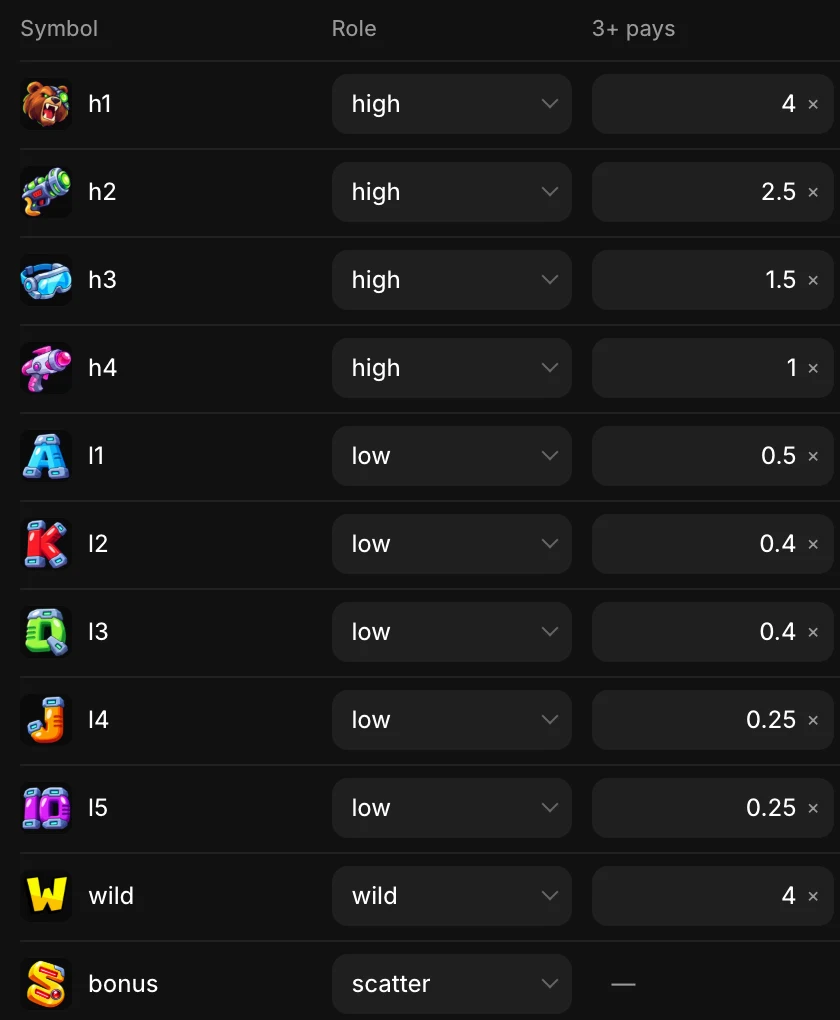
- It's the sum of parts. A game's RTP is the base game's contribution plus each feature's: free spins, multipliers, a hold-and-win round. Where you put the RTP changes how the game feels more than the headline number does.
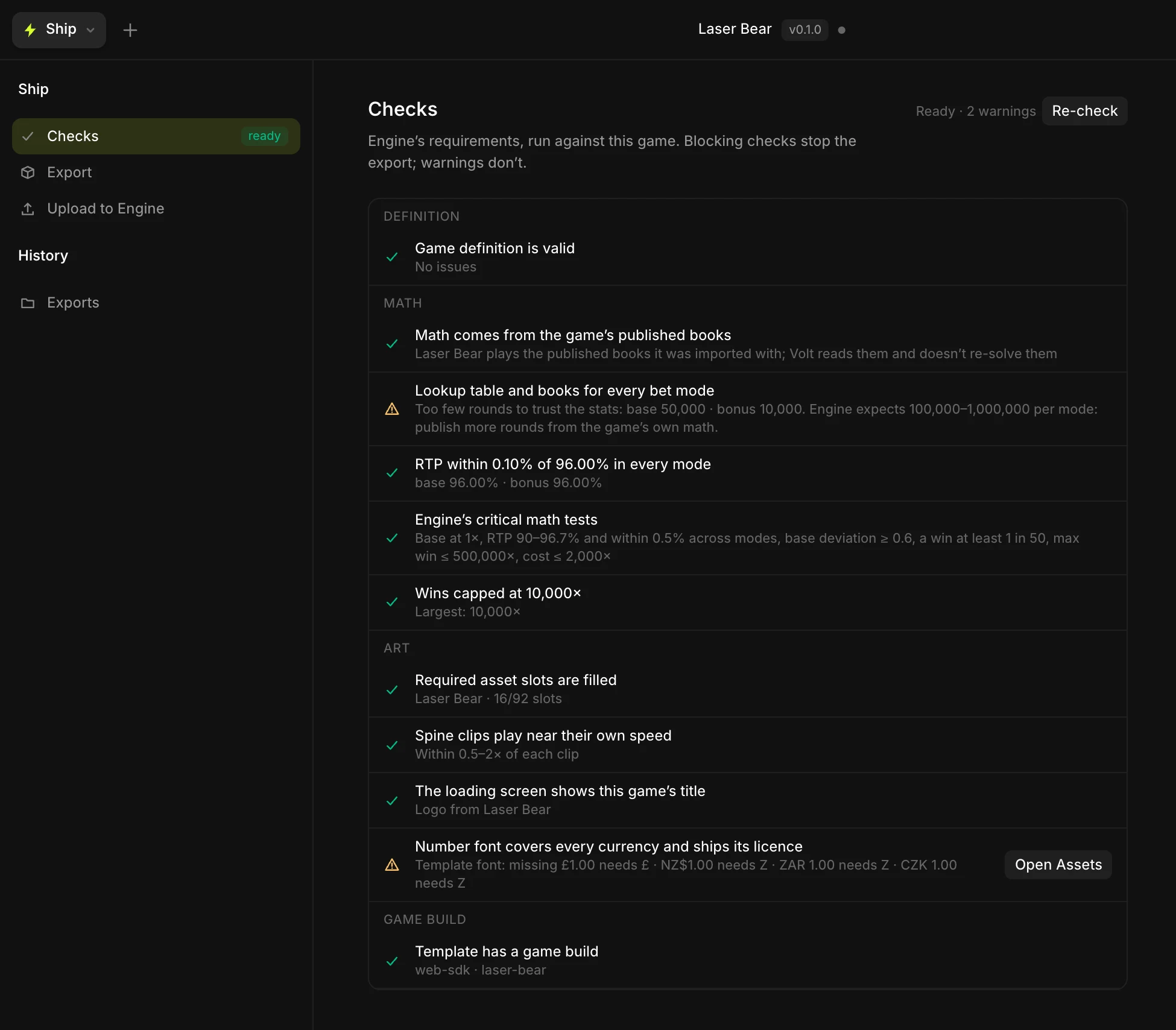
If a game sells a bonus buy (pay a fixed multiple of the bet to start the feature straight away), that mode has its own RTP, calculated over the bonus outcomes and the price. Platforms set rules for it: on Stake Engine, for example, every mode, bonus buys included, has to land between 96.0% and 96.7%.
Volatility: how unevenly it pays
Volatility (or variance) measures how spread out the wins are around the average. Mathematically it's usually given as the standard deviation of a single spin's result, measured in bets.
| Low volatility | High volatility | |
|---|---|---|
| Wins | Small and frequent | Rare, sometimes very large |
| Balance over a session | Drifts slowly | Long dry spells, then jumps |
| Where the RTP lives | Mostly in everyday line or cluster wins | Mostly in features and the top of the win ladder |
| Who it suits | Players who want a long session | Players chasing a big hit |
Two games with the same 96% RTP can sit at opposite ends of this table. Volatility is a design choice you make on purpose: it decides how often the feature comes, how big the multipliers go and how much of the pay table is spent on small wins.
Hit rate: how often a spin pays
Hit rate (hit frequency) is the share of spins that return anything. A hit rate of 25% means about one spin in four pays. It counts every win, including wins smaller than the bet, which is why a game can "hit" often and still lose money on most hits.
Hit rate is what players feel minute to minute. Too low and the game feels dead; very high, with tiny wins, and it feels like busywork. Designers tune it together with volatility: raise the hit rate by adding small wins, and something else (usually the feature or the top wins) has to give, because the RTP budget is fixed.
Max win and the win ladder
The max win is the largest single-round payout the game allows, expressed as a multiple of the bet (for example 5,000x or 10,000x). It caps the top of the distribution and decides how much RTP can sit in rare, huge outcomes. The win ladder (big win, mega win and so on) is presentation: the thresholds, in bets, where the game celebrates louder. It doesn't change the math, but it changes how the math feels.
Feature frequency
How often the bonus triggers, usually written as "1 in N spins", is the number players notice most after hit rate. A free spins round that arrives every 150 spins with modest wins and one that arrives every 400 with huge ones can carry the same share of RTP. Pick the one that fits the game you're making, then let the math solve the rest.
How the numbers trade off
Everything above draws on one budget: the RTP. Adding to one part means taking from another.
- More small wins (higher hit rate) leave less for features and big wins (lower volatility).
- A richer bonus (bigger multipliers, more spins) means it has to come less often, or the base game has to pay less.
- A higher max win needs those top outcomes to be rare enough to fit the budget.
That's why slot math is built by simulating the game's outcomes and then adjusting weights until the totals land on the targets: the RTP you need, at the volatility, hit rate and feature frequency you designed for.
How to use these numbers when you design a game
- Start from the feel. Decide how often the feature should come and how big a great round should be. That sets volatility.
- Fix the RTP target your platform expects, and split it between base game and features on purpose.
- Set the max win and the win ladder thresholds.
- Simulate, then tune the weights until RTP, hit rate and feature frequency land where you designed them, for every bet mode, including any bonus buy.
If you're publishing on Stake Engine, the Stake Engine guide covers how its math SDK turns this into the files you upload. In Volt, these numbers are settings in the Math workspace, which simulates every mode on your Mac.
Frequently asked questions
Is a higher RTP always better for players?
Over the very long run, yes: a higher RTP returns more of what's wagered. In a single session, volatility matters more. A high-volatility game with a high RTP can still lose most sessions.
What's a typical RTP for an online slot?
Many online slots sit in the mid 90s, often around 96%. Each platform sets its own range: Stake Engine requires every mode to be between 96.0% and 96.7%.
Does hit rate include wins smaller than the bet?
Yes. Hit rate counts any spin that returns something, so a game can hit often and still return less than the bet on most of those hits.
Is volatility the same as variance?
They describe the same idea. Strictly, variance is the square of the standard deviation; in slot design both words are used for how spread out the results are.
Does a bonus buy change the game's RTP?
A bonus buy is its own mode with its own RTP, calculated over the bonus outcomes and the price you pay. Platforms usually expect it to sit close to the base game's RTP.