Volt
Blog/Stake Engine
Shipping a slot to Stake Engine: the checklist before you upload
Volt team·9 min read·Oct 24, 2026
The short version. Before you press submit on Stake Engine, make sure the math passes the six critical tests in every mode, the front end follows the RGS rules and supports bet replay, the rules screen covers everything, the game reads right in social mode for stake.us, and the tile and cover art are set. Collect replay round IDs as you go. Then submit one front-end version and one math version together, because after approval only visual fixes are allowed.
This is the checklist we use. Each section links to the lesson in our free Stake Engine guide that explains it in full.
1. The math
- Every mode passes the critical tests: the cheapest mode costs 1×; 1× modes have a standard deviation of at least 0.6; every mode's RTP, bonus buys included, is between 96.0% and 96.7%; no mode pays more than 1,000,000× or costs more than 50,000×; at least one bet-level template fits. (Requirements)
- Enough rounds: 100,000 to 1,000,000 simulations per mode for slots, with a win-cap round actually in the books.
- The risk tier you want: decide whether you're aiming for 3-Star bet limits (max win 100,000×, cost 5,000×, and the tail limits) before you finalise the feature; failing them doesn't block you but lowers the maximum bet.
- The files:
index.json, a lookup table and a compressed books file per mode, payouts matching exactly between them, mode names of up to 32 letters, numbers, dashes or underscores. (The math SDK) - Mode names for stake.us: no "buy", "bet" or "pay", and the same names in the game, replay and math files.
2. The front end
- Nothing hard-coded: not the RGS address, not bet levels, not the default bet. Reviewers launch with an invalid
rgs_urland expect an error. (The front end) - Round handling: an active round restores its bet on reload;
/playisn't called without enough balance;/end-roundonly for winning rounds. - Controls: every bet level reachable, balance shown, win counter counting up, sound off, space bar spins, confirmation for autoplay and for any mode costing more than 2× the base bet.
- Sizes: mobile and the mini-player (Popout S and L), no scrolling, double-tap zoom off.
- Assets: your own art and sound (no web-SDK samples, no Stake Engine logo or loader), everything loaded from the build, a reasonable bundle size.
- Money: sub-cent wins shown precisely; USD, EUR, CAD, MXN and JPY all correct; XSC and XGC in social mode with no "$" prefix.
3. Bet replay
- Replay mode works from the URL alone (
replay=truewith game, version, mode and event), with no session and no authenticated calls. - It shows Play, then Play Again, hides the bet controls, shows the real cost, and works in the small popout.
- You have round IDs per mode for a normal win, a big win, the win cap, a loss and a bonus trigger. Forcing those rounds while you test is the easy way to collect them; see Testing a slot.
4. The rules screen and disclaimer
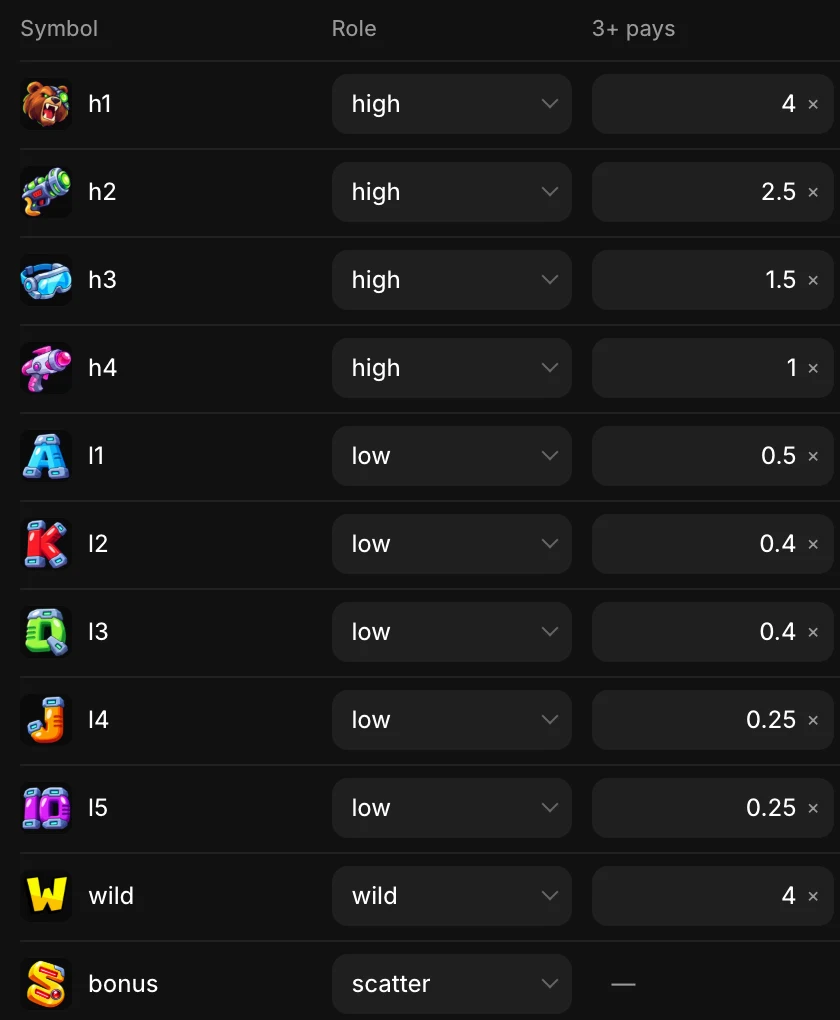
The rules, the RTP of the game and of each mode, the max win per mode, every symbol's payouts, special symbols' values, feature trigger and retrigger rules, each mode's cost, and every point of Engine's general disclaimer. Reviewers check them against the math, so they have to agree with the final numbers.
5. stake.us wording
Turn on Studio's Social Mode and read every screen: autoplay menus, buttons, the rules, the bonus buy. Engine's table of restricted terms covers the usual slips (bet → play, buy bonus → get bonus, pay → win, cash → coins). "Total Bet" in an autoplay menu and "Buy" on a bonus button are the classic misses.
6. Studio's own checklist
- A 3:4 tile set as the cover and a 16:9 cover image in the media library (tiles are built in Studio's Media Editor; bright artwork, no promotional text or multipliers).
- A published front-end version and math version.
- Within the open-review limit: one at a time until your first game is live, five after that.
- Distribution chosen (only on Stake, or Stake and the Engine network); it can't change after launch. (Getting paid)
7. A last pass, then submit
Run Engine's AI review prompt against the project; it isn't an approval, but it catches what slipped. Then submit, knowing that after approval "only minor updates to address visual issues are permitted": no math changes, no new modes, no new mechanics. (Review and star ratings)
How Volt does it
Volt's Ship workspace runs Engine's requirements against your game before you export: the game definition, the lookup tables and books for every mode, the RTP against your target, Engine's critical math tests, required art, the loading screen's title and the number font's currency coverage. It says which checks block the export and which are only warnings, with a button to the page that fixes each. Export writes the math files and the game build side by side, and Upload to Engine walks through which folder goes where.
Frequently asked questions
What do I need before I can submit a game on Stake Engine?
A published front-end version and math version, math that passes every critical test with at least one bet-level template that fits, a 3:4 tile and a 16:9 cover image, and room under the open-review limit.
Why does Stake Engine ask for round IDs?
So reviewers can replay specific rounds: per mode, a normal win, a big win, the win cap, a loss and a bonus trigger.
Can I fix the math after my game is approved?
No. After approval only minor visual fixes are allowed, so finish the math and features before you submit.
Do I need a separate version for stake.us?
No. Games are considered for stake.us automatically if they pass the wording rules in social mode, so test with Studio's Social Mode toggle.
Requirements as documented by Engine on October 22, 2026; check Engine's approval guidelines before you submit.